
Deafness Resources
Signs of Life: Australia's Deaf
Community (40 minutes, A/V Production Unit, Brisbane College of Advanced
Education) seeks to banish stereotypes of deaf people. The video shows deaf
people-from young children to senior citizens-leading normal, purposeful lives,
participating in the range of activities which their community supports,
working, playing, socialising, and talking about their lives with inspiring
candour, insight, and humour. Price $65.00.
Deaf Children, Their Families and Professionals-Dismantling
Barriers by Sarah Beazley and Michele Moore. London: David Fulton
Publishers, 1995.
This publication is about taking disablement out of the
experience of children and their families. It focuses on deaf children and uses
a valuable combination of what families say and discussions of topical issues
about how disabling experiences can be avoided. Parents and children clearly
reveal the social barriers to their lives as ordinary families, and the ways in
which they have identified ways in which such barriers can start to be
dismantled. Professionals and students in the field of education, health and
social work are challenged to re-examine their own practices and beliefs to
maximise enablement of vulnerable children and their families.
For a full list of resources available, contact Deafness Resources Australia, Locked Bag No 5380, Parramatta NSW 2124, Tel (02) 9204 2970 TTY (02) 9204 2971 Fax (02) 9204 2972.
Australian Reconciliation Convention
The Australian
Reconciliation Convention is a landmark, mid-term event in the life of the
Council for Aboriginal Reconciliation. It provides a unique opportunity for
Australians from a wide range of backgrounds to be involved in shaping a more
confident, mature and harmonious nation for the centenary of Federation in
2001. The Convention provides an opportunity to review progress in the
reconciliation process so far, but its main task will be to set the agenda for
the future.
Early in 1997, the Council will publish a series of booklets on subjects relevant to the reconciliation process and to the Convention. These booklets will provide a framework for discussions at regional meetings around the country leading up to the Convention. Reports from these meetings will provide a focus for Convention discussions: community groups, organisations and individuals will be encouraged to express their views.
To find out more about the Convention, or to be involved in the consultation process, contact The Meeting Planners, Australian Reconciliation Convention, 108 Church Street, Hawthorn VIC 3122, or for telephone enquiries: (06) 271 5120.
 |
 |
| Reproduced with permission of the artist |
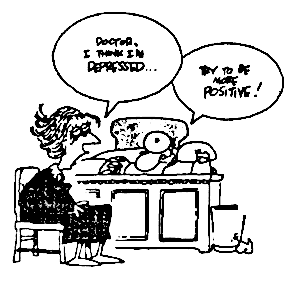
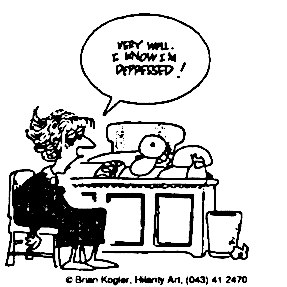
Overcoming Depression: Video
Me Depressed? Don't Make me
Laugh! is an instructional video produced in Australia. Intended as a
self-help tool for sufferers of depression, it has also been used by health
professionals in clinical and teaching situations. The video teaches techniques
for managing depression based on cognitive behaviour therapy. This video is
presented by Spike Milligan, a very high profile and long time sufferer of
severe depression. It is made in a semi-documentary style in which four people
who suffer from depression talk about their depression and the techniques they
have used to manage it. These techniques are taught to the viewer in plain
language by these four, as well as by Professor Philip Boyce, Professor of
Psychiatry at the University of Sydney. This video is available through the
producers, Monkey See Productions, PO Box 3010, Waverley NSW 2024. Tel (02)
9389 8062 Fax (02) 9389 8546. Price for libraries: $65.00; postage/handling
$5.00.
Transcultural Mental Health Network
The mission of the
Australian Transcultural Mental Health Network (ATMHN) is to improve the
quality and accessibility of mental health services available to people of
non-English speaking background. The ATMHN is a three year program, which
commenced in November 1995. The ATMHN aims to assist and support those who are
trying to establish or develop services through the collection and
dissemination of information; the development of national strategies for
service development, education and research; and the funding of a limited
number of special projects.
The ATMHN has an Advisory Board which has representatives of consumers and carers, NESB community organisations, non-Government organisations, each State and Territory, and the specialist Transcultural Mental Health Centres in those States where such centres have been established.
The ATMHN offers a number of services, the most important of which is the Information Service. This service is made up of two interrelated components - the Library and the ATMHN website. The library holds a specialised collection of monographs, reports, journals and audio-visual materials, covering issues of ethnicity, transcultural mental health, service provision to ethnic communities, psychiatry, culture and government initiatives. The collection is searchable via the ATMHN website or by visiting the library itself. The website has been established to assist in the provision and exchange of information on transcultural mental health issues.
For further information about the ATMHN contact Mr Peter Wellington, Coordinator ATMHN, 12 Gertrude Street, Fitzroy VIC 3065. Tel (03) 9415 9522 Fax (03) 9415 1312 Internet address: http://ariel.unimelb.edu.au/~atmhn/.
Kit: Eradication of Poverty 1996
A kit has been prepared by
the Federal Government Department of Social Security on the International Year
for the Eradication of Poverty 1996. It includes:
For further information and copies of the kit contact the International Policy and Liaison Section, Department of Social Security, PO Box 7788, Canberra Mail Centre ACT 2610. Tel (06) 244 7756 Fax: (06) 244 5901. Internet address: http://www.cin.gov.au/.
ACC News
The Australian Caption Centre and the Victorian
School for Deaf Children Inc. have combined resources to look at the usage of
captioning in schools. The results of this survey will be available from the
ACC in a few month's time.
The Australian Caption Centre also has information on Deafness Resources Australia's National Deafness Information Service. This information service contains even more information about captioning and the Australian Caption Centre. The Internet address for client software is: gopher.slnsw.gov.au/1/DRA. For www browser software, the address is: gopher://gopher.slnsw.gov.au/1/DRA
Everyday Social Interaction
Everyday Social Interaction: A
Program for People with Disabilities by Vivienne C Riches. Sydney:
MacLennan & Petty, 1996. Price: $60.00.
This publication provides a
step-by-step program for teaching basic verbal and non-verbal interactive
skills to adults and young people with mild to moderate disabilities. A chapter
devoted to friendships and relevant issues illustrates how combining these
skills can generate successful and lasting interactions. Everyday Social
Interaction is available from MacLennan & Petty Pty Ltd, PO Box 145,
Rosebery NSW 2018. Tel (02) 9669 5755 Fax (02) 9669 5997.
WA Multicultural Awards
The City of Melville Public Library
Service has won the 1996 award for services to multicultural communities for
their Social English Club which provides a forum for adults from both
non-English speaking backgrounds and English speaking background who wish to
converse in English, irrespective of fluency through an informal process. The
club also enables members to meet other residents from diverse cultural
backgrounds.
Second prize went to the Shire of East Pilbara for their Marble Bar Public Library holiday program which enjoyed outstanding success in introducing the library and its facilities to the largely Aboriginal junior population of the town.
The award, presented by the Library Board of Western Australia with
sponsorship from the Office of Multicultural Interests and the Aboriginal
Affairs Department, recognises and encourages public library initiatives in the
provision of services to culturally diverse communities in Western
Australia.
For more information contact: Tel (09) 427 3124 Fax (09) 427
3169.